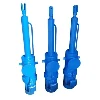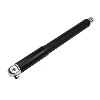
The hydraulic control valve assembly primarily consists of a relief valve, suction check valve, speed control valve (optional based on user requirements), and a pilot-operated check valve (hydraulic lock). Valve combinations with various functions can also be designed to meet specific operational requirements based on the actuator's characteristics. Locking configurations include self-locking upon extension, self-locking upon retraction, or self-locking in both directions; speed options include adjustable and fixed-speed models; and operating orientations include horizontal, upward (including inclined upward), and downward (including inclined downward) pushing. The electro-hydraulic actuator offers the following key advantages:
(1) Compact structure, easy installation, space-saving design, and simple maintenance.
(2) Capable of starting under load and equipped with overload protection.
(3) The circuit features a bidirectional hydraulic lock, allowing the actuator to stop and self-lock at any position within its stroke range while maintaining constant output force.
(4) Pushing/pulling force and speed (optional) are infinitely adjustable, offering a wide range of driving forces.
(5) Self-locking capability upon unexpected power loss prevents accidents.
(6) Utilizes a fully hydraulic drive system for responsive action and smooth operation; effectively cushions external impacts and ensures precise stroke control (≥0.5mm).
(7) Features a fully enclosed, integrated electromechanical-hydraulic structure; the hydraulic fluid circulates within a sealed, unpressurized steel cylinder. This compact design prevents oil leakage and-even in harsh environments-keeps out dust and water, prevents internal corrosion, and ensures a long service life.