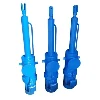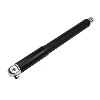
The plow-type unloader further overcomes the shortcomings of all older models. Thanks to improvements such as a dual-plow design (front and rear) and versatile installation options-including a locking mechanism and a system supporting both manual and electric operation, as well as a mechanical self-locking feature-it stands as the most advanced machinery for unloading and diverting coal in China.
1. The plow head assembly consists of a front section made of high-chromium-manganese alloy or asbestos-based material and a rear section made of wear-resistant rubber sheeting, ensuring cleaner material discharge.
2. The plow head features a mechanical "grab-and-pull" locking mechanism that allows for height adjustment, ensuring the blade maintains optimal contact with the conveyor belt. During operation, the blade remains stable-without lifting or vibrating due to the impact of the coal-thereby preventing belt tearing, abrasion, and coal spillage.
3. The drive unit utilizes a state-of-the-art, dual-mode (manual/electric) mechanical electro-hydraulic pusher. This design overcomes the flaws of standard electric pushers (such as poor overload capacity, motor burnout, jamming, and screw rod bending) and the issues common to ordinary electro-hydraulic pushers (such as internal/external leakage, lack of self-locking, sliding, and erratic movement). The dual-mode mechanical electro-hydraulic pusher offers absolute self-locking, zero leakage, exceptional overload capacity, and smooth operation.
4. Three installation configurations (A, B, and C) are available: mounting the pusher atop the coal diverter, vertical installation, or side-mounting on the conveyor belt structure, offering great flexibility for the customer.
5. The air-lock flap is constructed from wear-resistant high-manganese-chromium alloy, extending its service life to up to 20 years and reducing maintenance requirements.
6. Air-lock functionality: (1) Ensures uniform material distribution, preventing belt mistracking, material adhesion, and spillage along the conveyor path. (2) Minimizes induced airflow, reducing it to less than 10% of original levels. (3) Suitable for conveying sticky, wet, large-lump, or powdery materials, effectively preventing adhesion and clogging.