



Rake Gate
Discharge and Screen at Once
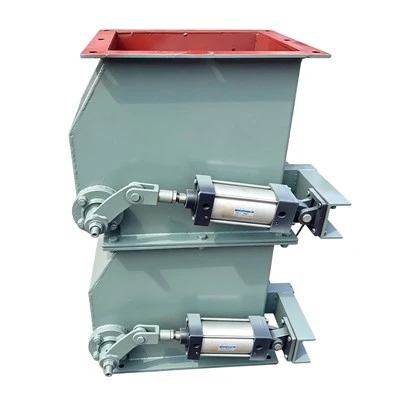
The Rake Gate combines material discharge with basic particle-size screening. Parallel rake bars are installed across the gate opening, creating fixed gaps through which smaller particles can pass. Material larger than the selected gap remains above the bars or is pushed away as the gate moves. This allows the gate to control discharge while separating material by size. Opening sizes range from 500×500 to 1400×1400 mm. The bar gap can be selected according to the required cut size, with standard options of 10, 20, 30, 50, 80, and 100 mm. For example, a 30 mm gap allows smaller particles to pass while retaining larger pieces above the bars. The bars are made from high-manganese Mn13 steel, with individual bar diameters of 20–40 mm. The drive uses a parallel electro-hydraulic actuator with 15–40 kN of thrust and a stroke of 300–700 mm. Three operating positions are available: partially open for screening, fully open for full-bore discharge, and fully closed for material shutoff. Because gaps remain between the bars even when closed, the leakage rate is approximately 10%, so the gate is not intended for applications requiring air-tight isolation.

Bars Straightened Before Assembly
The Rake Gate is manufactured according to GB/T 10595-2017 and JB/T 12705-2016. The factory uses a dedicated straightening process to control the straightness of the rake bars before assembly. The bars are cut from round steel after the full-length material passes through a five-roller straightening machine. After straightening, bar straightness is controlled within 0.5 mm per meter. Because the bars are installed in parallel with relatively narrow gaps, bending in a single bar can change the clearance between adjacent bars. An excessive gap can allow too much material to pass, while an insufficient gap can restrict the flow and increase the risk of blockage. Straightening the bars before cutting and assembly helps maintain consistent spacing and more uniform material flow across the gate.

Specifications
|
Parameter |
Content |
|
Opening size |
500×500 to 1400×1400 mm |
|
Bar gap options |
10 / 20 / 30 / 50 / 80 / 100 mm |
|
Bar material |
High-manganese Mn13 steel |
|
Single bar diameter |
20–40 mm |
|
Drive type |
Parallel electro-hydraulic actuator, 15–40 kN thrust, 300–700 mm stroke |
|
Operating modes |
Partially open for screening / fully open for discharge / fully closed for material shutoff |
|
Wear life |
Mn13 bars, at least 24 months under sand and mining applications |
|
Leakage rate |
Approximately 10%; not intended for strict airlock applications |
|
Standards |
GB/T 10595-2017, JB/T 12705-2016 |
|
Common applications |
Sand and gravel, mining screening and grading |
FAQ
Q: Can this gate fully stop the material?
A: It can stop most of the material flow when fully closed, but gaps remain between the rake bars. The leakage rate is approximately 10%, so it is not suitable where a tight airlock or complete sealing function is required.
Q: How do I choose the bar gap?
A: Select the gap according to the required particle-size cut. For example, a 30 mm gap allows smaller particles to pass through while retaining larger particles above the bars.
Hot Tags: rake gate, China rake gate manufacturers, suppliers, factory, 3 Way Gravity Diverter Valve, Double Flap Airlock Valve, Louver Valve, Rake Gate, Silo Slide Gate, slide gate
Previous
4 Way Gravity Diverter ValveNext
Louver ValveYou Might Also Like


Send Inquiry